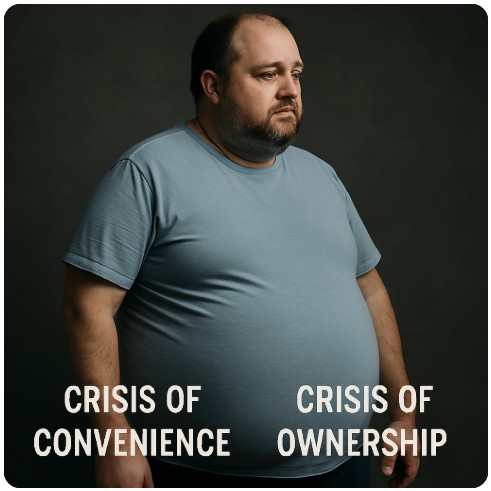
What is obesity, really?
Obesity isn’t a feeling—it’s a measurable health risk. Medically, a person is considered obese when their Body Mass Index (BMI) is 30 or above. That’s not subjective. It’s a globally accepted standard tied to higher risks of diabetes, heart disease, and early death. You can calculate your own BMI using this CDC calculator in 30 seconds.
In the U.S., more than 40% of adults are classified as obese. Globally, that number is closer to 16%. That gap is not just about genetics or bad luck—it’s about systems, culture, choices, and mindset.
The two biggest drivers of the crisis
The American obesity epidemic is fueled by two major forces:
- The modern diet. Our food supply is overloaded with ultra-processed, calorie-dense, low-nutrient options. They’re cheap, addictive, and heavily marketed as healthy because they say “low-fat” or “gluten-free” on the label. But they’re far from real nourishment.
- A sedentary lifestyle. Technology and convenience have replaced movement. Most Americans sit more than they move, and it’s taking a massive toll on our health over time.
Yes, these are societal challenges. But they aren’t the whole story.
If your store has a health food section, what do you call the rest of the store?
The deeper issue: rationalization and self-deception
What makes this crisis so stubborn is the way we lie to ourselves—often without realizing it. We say things like:
- “I’m not that unhealthy.”
- “Life is meant to be enjoyed.”
- “I don’t eat that bad.”
- “At least I’m not as big as [insert someone else].”
- “It’s too expensive to eat well.”
But denial doesn’t change the data—or the consequences. Health isn’t about comparison. It’s about personal ownership. It’s about whether our daily decisions align with what we say we want: energy, mobility, confidence, longevity, and to just feel good.
You REALLY don’t need perfection—just consistent ownership
One of the biggest myths is that getting healthy requires going all-in, all at once. Or that it will be a cramp on your life, be painful and not worth the difficulty. But the truth is, most change happens through small, repeatable actions. You don’t need a degree in nutrition or a personal trainer. You just need to do the simple things consistently:
- Track steps. If you walk 3000 a day, get to 4000
- Eat mostly real food. If it has more than 5-7 ingredients, it’s not healthy
- Sleep well. Hydrate often. Repeat.
It’s not glamorous, but it works.
Why I’m writing this
Because I see the suffering and I know it does not need to be this way.
I see parents who can’t keep up with their kids. I see adults who won’t travel because they’re ashamed of their bodies or unable to walk very long or fit comfortably on a plane. I see people chained to prescriptions, managing diabetes and chronic pain that could have been prevented.
And I’ve seen the long-term consequences through my dad. He spent decades overeating and smoking, and while he didn’t die suddenly, he suffered many years. He lived the last decade of his life in pain—fighting heart failure and diabetes, to name just a couple of issues, constantly in and out of doctor’s offices, stuck in a body that couldn’t keep up with the life he wanted. He didn’t just die prematurely. He suffered unnecessarily.
That’s what I’m trying to raise awareness about. Not to shame, but to challenge. Not to criticize, but to call people back to their power. To show that it doesn’t have to be this way. You and the ones you love can live longer, feel better, and experience and give more joy.
I am not Mr. Fit, and despite what some may think after reading this, I am not overly restrictive in my diet. I eat smart, don’t care about mico-nutients and all that crap. I have kept it simple, over a long time and you can do the same!
 Alcohol, Marriage, Personal Growth and More
Leave a comment