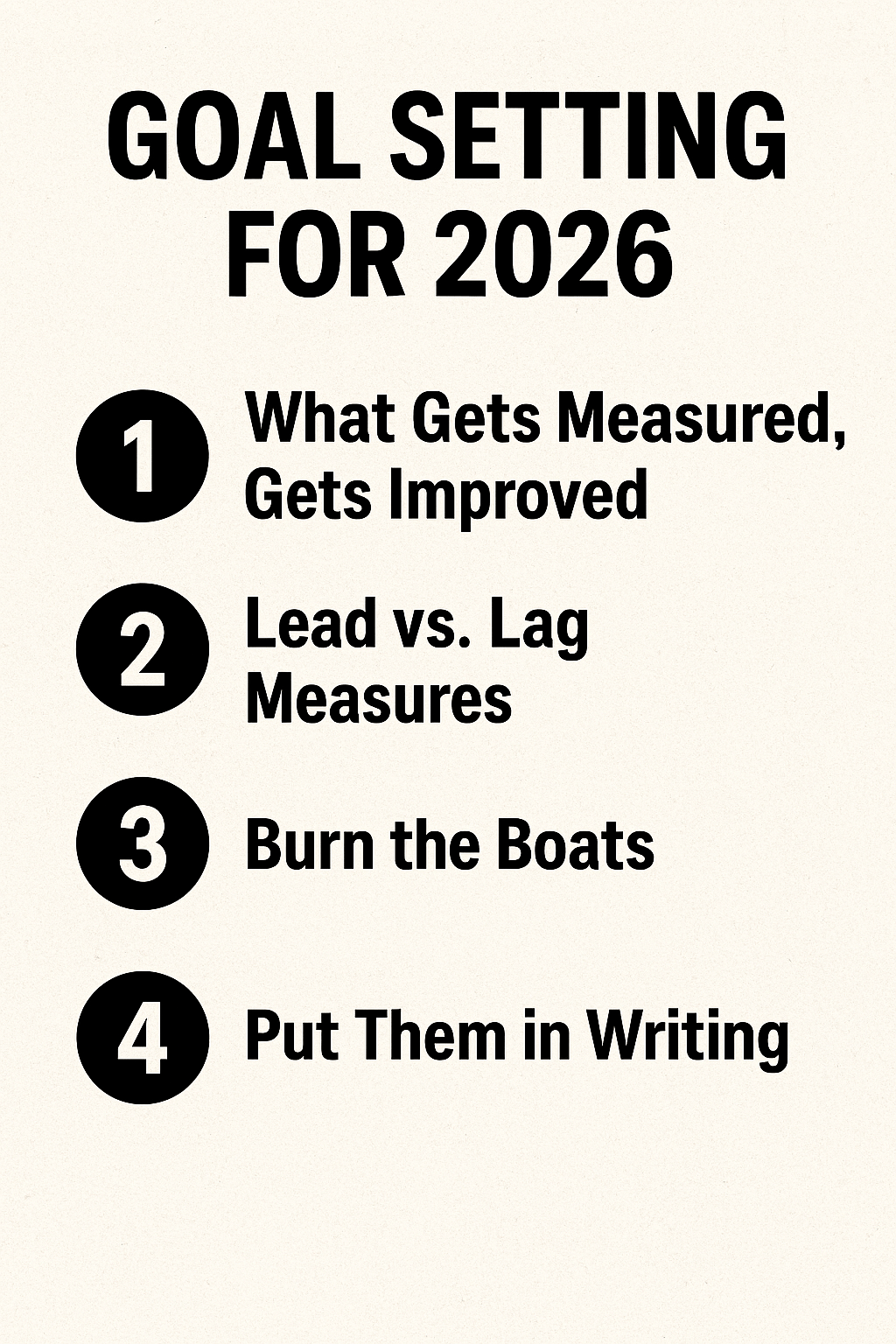
If you’re starting to think about goals and resolutions for 2026, you might find this helpful.
As an avid goal setter and someone who’s perpetually looking to grow and optimize, I’ve learned a lot (and tried a lot) on this subject. If you ask 100 people their opinion about goal setting, you’ll probably get 150 different answers—and that’s ok. Each person’s approach to goals and resolutions is highly personalized.
But here’s what’s true: goals matter. Whether you’re focused on finances, career, health, or happiness, goals set the ship (you) off in a direction that increases your odds of actually getting where you want to go. Living day in and day out without direction usually means drifting past the dreams, achievements, personal milestones, or legacy ideas you care about.
And if you’re someone who opposes goals and planning, that’s ok too. If you’re genuinely happy and satisfied with things exactly as they are, then great. But if you’re looking for growth, clarity, or momentum, goals are the simplest lever you can pull.
So let’s dig in. Here are the three concepts that most influence how I set and manage my personal goals.
1. What Gets Measured, Gets Improved
Failure lives in the world of uncertainty. This is true in business and in life.
If you set a goal to lose 20 lbs by June 1st, how will you know if what you’re doing is actually working? This unknown is where goals go to die. We all have a knack for fooling ourselves with lines like, “I skipped dessert twice this week,” or “I hit the gym an extra time last month.” Those things may be true, but they’re usually inconsequential in moving the needle.
Measurement eliminates self‑deception. It replaces vibes with data. And data is what drives improvement.
2. Lead vs. Lag Measures
This concept comes from the book The 4 Disciplines of Execution (4DX) by Chris McChesney, Jim Huling, and Sean Covey.
- Lag measures are the results that show up after effort. Example: the number on the scale. When you step on it, there’s nothing you can do in that moment to change it. It reflects past behavior.
- Lead measures are the behaviors that cause the lag measure to change. Example: tracking calories Monday–Friday or increasing your daily steps from 3,000 to 8,000. These actually change outcomes.
So maybe the goal isn’t “lose 20 lbs.” Maybe the real goals are the two lead measures that will produce that outcome. When measured regularly, lead measures drastically increase your odds of hitting the lag measure.
3. Burn the Boats
“Burning the boats” is the idea of committing so completely to a course of action that all avenues of retreat are intentionally removed. The phrase comes from historical accounts of leaders like Hernán Cortés destroying their own ships to force total focus, unity, and forward momentum.
What does this mean for your 2026 goals?
It means that for the 1–2 goals that truly matter, you may need to go all in. Not every goal requires this level of commitment, but the big ones—the ones that change your life—usually do.
Example: Goal: Increase your annual salary from $130K to $150K in 2026. Burning the Boats: Enroll in an AI evening course at the local college (paid upfront), hire a professional résumé writer, delete social media apps for 60 days to reinvest time into job searching, and ask a friend or family member to hold you accountable—or even better, join you.
This is what “no retreat” looks like in real life.
4. Put Them in Writing
Studies show that writing down your goals increases your likelihood of achieving them by 20% to 42%. It’s simple, but it works. Even better: rewrite them weekly in a notebook or on your phone. Your brain will do the rest.
You’ve probably heard of the SMART method (Specific, Measurable, Attainable, Relevant, Time‑bound). It’s fine, but I prefer a cleaner, more actionable format borrowed from 4DX:
From X to Y by When.
It forces clarity. It forces measurement. And it forces a deadline.
Examples
Goal #1: Increase average daily steps from 8,100 in 2025 to 10,000 in Q1 of 2026. Lead measure: Track steps daily (zero‑effort with an Apple Watch).
Goal #2: Increase monthly savings rate from 8% in 2025 to 12% by June 2026. Lead measures: Review subscriptions quarterly, cook at home three nights a week, and redirect your annual raise straight into savings before lifestyle creep gets a vote.
Wrapping It All Up
Goal setting isn’t about perfection, pressure, or pretending to be someone you’re not. Goals should be very personal and align with what matters most to you. It’s about clarity. It’s about choosing a direction on purpose instead of drifting into another year hoping things magically improve. And it’s about stacking the deck in your favor with simple, proven tools:
- Measure what matters.
- Focus on the behaviors that change outcomes.
- Burn the boats when it counts.
- Write the goals down.
If you do those four things, you dramatically increase your odds of getting what you want—whether that’s better health, more money, deeper relationships, or simply a life that feels more aligned with who you’re becoming.
2026 is coming either way. The only question is whether you meet it with intention or coasting. My vote? Pick a few goals that matter, write them down, measure them, and go all in. Your future self will thank you for the clarity and the courage.
 Alcohol, Marriage, Personal Growth and More
Leave a comment